

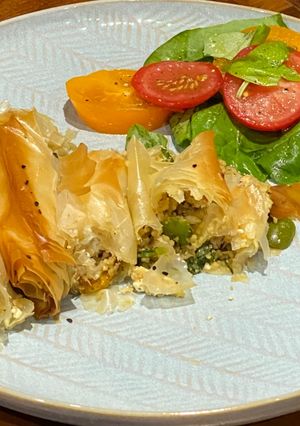
Sicilian Serpente - M’hencha

Sicily is a polychrome, rare jewel strategically located between Africa and Italy. Phoenicians, Greeks, Romans, Byzantines, Arabs, Normans, Swabians and Aragonese have all populated and embellished the island with architectural works and dishes with intense flavours.
The Greeks colonized Sicily between the 8th and 6th centuries BCE, greatly contributed to the definition of Sicilian cuisine, bringing to the island the art of wheat and wine production and imported oregano, dried fruits, honey and olive trees.
The vibrant street markets abound with colourful delights that inebriate the air with strong, spicy flavours. Even the most renowned restaurants serve street food at all hours; arancine (rice balls stuffed with an array of fillings shaped like Mt. Etna) to panelle (chickpea fritters) and crocché (croquettes) and some more unusual dishes such as pani ca meusa (spleen sarnies), frittola (scraps of calf entrails, boiled then fried crisp in lard) or stigghiola (skewered lamb/veal intestines wrapped around onions and parsley and chargrilled).
M’hencha is from the Arabic word Hench meaning serpent (snake). This serpent-shaped pastry is made with a dough called Diouls sheets which are layered, filled and baked.
This dish combines typical Sicilian ingredients which are infused with Greek and North African flavours, wrapped in the delicate Diouls sheets (filo) and baked to create a pastry that is shatteringly crispy with a punchy filling. #ChristmasGift
Sicilian Serpente - M’hencha
Sicily is a polychrome, rare jewel strategically located between Africa and Italy. Phoenicians, Greeks, Romans, Byzantines, Arabs, Normans, Swabians and Aragonese have all populated and embellished the island with architectural works and dishes with intense flavours.
The Greeks colonized Sicily between the 8th and 6th centuries BCE, greatly contributed to the definition of Sicilian cuisine, bringing to the island the art of wheat and wine production and imported oregano, dried fruits, honey and olive trees.
The vibrant street markets abound with colourful delights that inebriate the air with strong, spicy flavours. Even the most renowned restaurants serve street food at all hours; arancine (rice balls stuffed with an array of fillings shaped like Mt. Etna) to panelle (chickpea fritters) and crocché (croquettes) and some more unusual dishes such as pani ca meusa (spleen sarnies), frittola (scraps of calf entrails, boiled then fried crisp in lard) or stigghiola (skewered lamb/veal intestines wrapped around onions and parsley and chargrilled).
M’hencha is from the Arabic word Hench meaning serpent (snake). This serpent-shaped pastry is made with a dough called Diouls sheets which are layered, filled and baked.
This dish combines typical Sicilian ingredients which are infused with Greek and North African flavours, wrapped in the delicate Diouls sheets (filo) and baked to create a pastry that is shatteringly crispy with a punchy filling. #ChristmasGift
 Open in Cookpad App
Steps
- 1
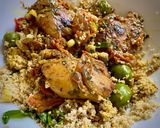
Wash the chicken in lemon water and pat dry. Rub the chicken thighs with the ras el hanout and season with salt. Heat 1 tbsp of the oil in a large frying pan over a medium heat and add the chicken thighs, skin-side down. Cook for 10 mins until the skin is golden and crispy. Turn the chicken over and cook for a further 5 mins, then remove from the pan.
- 2
Fry the red onion in the remaining juices until light brown and crispy then add the garlic. Pour over 300ml of stock, add the sundried tomatoes, cherry tomatoes, olives, preserved lemon and chilli, stir then add the chicken back into the pan. Cover and cook for 10 minutes until the sauce has thickened. Remove from the heat, adjust the seasoning and add half the parsley and half the coriander. Set aside to cool.
- 3
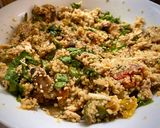
Meanwhile, put the couscous in a large heatproof bowl and pour over the remaining 200ml of stock, cover and set aside for 5 minutes. Fluff with a fork, stir through the spinach, lemon zest and the remaining coriander and parsley. Season to taste with freshly ground salt and pepper.
- 4
Once the chicken has cooled, remove the chicken from the sauce and shred with two forks. Add the sauce to the couscous and fold back in the chicken.
- 5
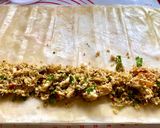
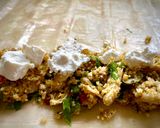
Take a sheet of filo and place on a non-stick surface, long edge facing. Brush with melted butter and place over a second sheet. Brush the second sheet with butter and place the third sheet on top. Brush again with the butter. Place the chicken and couscous filling along the long edge, 1cm in from the end and sides. Dot with pieces of ricotta.
- 6
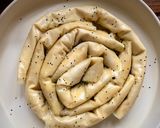
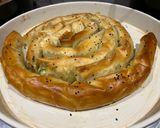
Roll the pastry over into a sausage shape, brushing with butter as you turn it over, then brush the final edge with butter to seal. Pinch the ends together then curl it into a coil like a snake and place in a buttered round dish. Repeat again with three sheets of the filo and filling and ricotta and wrap around the first circle. Repeat again with the third set. Brush the whole snake with butter and sprinkle on the kalonji seeds. Bake in the oven 180 degrees C for 30-35 minutes until crisp a
- 7
Serve with a salad of tomatoes, baby spinach and basil leaves, grind of salt and drizzled with a little extra virgin olive oil.

Similar Recipes
More Recipes
-

-

-

-

-

-

-

-

-
-

-

-

-

-
-
-

-

-

-

-







Comments