

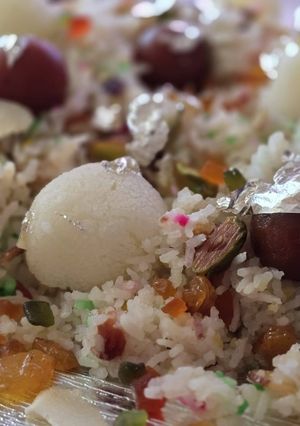
Mutanjan

I have always wanted to make mutanjan, or you can say satrangi meetay chawal (seven coloured sweet rice) or colourful zarda, or wedding feast sweet rice. Somehow I kept putting it off.
I knew the basics, and honestly, it’s quite simple to make. What held me back was the thought of using different food colours. The food colours available here in Canada are just not the right kind for this dessert.
Today I decided to give it a try. I simply cannot keep putting it off because of such a silly reason!
Mutanjan traces its roots back to the Mughal era cuisine. It featured tender pieces of meat (beef, mutton, chicken) with sweet rice. It was finished off like biryani, in layers—rice, syrup, meat, and nuts.
Over the years it evolved in Pakistan, omitting the meat, and became sweet rice!
For this mutanjan, boil the soaked rice till 60% cooked. And then drain it. You can divide the rice into portions and add different food colours. Or you can just add a drop of each food colour in different places on the rice and place on dum.
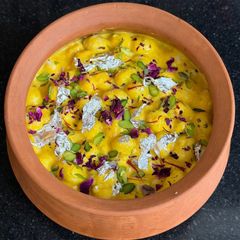
Roast the nuts in ghee and then add make a simple syrup to cook the rice again. Just before dum (tight simmer) add the coloured rice and cook for 10-15 minutes. Rest the rice then fluff and serve. Fragrant, colourful, and dotted with nuts and dried fruits, it is as beautiful as it is delicious.
Serve it warm or at room temperature, and watch this colourful dessert disappear from the table!
Mutanjan
I have always wanted to make mutanjan, or you can say satrangi meetay chawal (seven coloured sweet rice) or colourful zarda, or wedding feast sweet rice. Somehow I kept putting it off.
I knew the basics, and honestly, it’s quite simple to make. What held me back was the thought of using different food colours. The food colours available here in Canada are just not the right kind for this dessert.
Today I decided to give it a try. I simply cannot keep putting it off because of such a silly reason!
Mutanjan traces its roots back to the Mughal era cuisine. It featured tender pieces of meat (beef, mutton, chicken) with sweet rice. It was finished off like biryani, in layers—rice, syrup, meat, and nuts.
Over the years it evolved in Pakistan, omitting the meat, and became sweet rice!
For this mutanjan, boil the soaked rice till 60% cooked. And then drain it. You can divide the rice into portions and add different food colours. Or you can just add a drop of each food colour in different places on the rice and place on dum.
Roast the nuts in ghee and then add make a simple syrup to cook the rice again. Just before dum (tight simmer) add the coloured rice and cook for 10-15 minutes. Rest the rice then fluff and serve. Fragrant, colourful, and dotted with nuts and dried fruits, it is as beautiful as it is delicious.
Serve it warm or at room temperature, and watch this colourful dessert disappear from the table!
 Open in Cookpad App
Steps
- 1
Bring water to a boil and add the rice. Cook till 60% cooked. Drain and set aside.
- 2
Melt ghee in a wok and add cinnamon, cloves and cardamoms. Sauté for 1 minute.
- 3
Add the nuts sauté for 1 minute. Remove half and set aside.
- 4
Add milk and bring to a boil.
- 5
Add sugar and mix to dissolve completely. Bring to a boil.
- 6
Add the rice and mix/fold with gently hands.
- 7
Cook till liquid evaporates.
- 8
Place a drop of each food colour in different places.
- 9
Cover and simmer for 10-15 minutes.
- 10
Uncover and gently fluff the rice, mixing the coloured rice with white.
- 11
Serve hot or warm garnished with reserved nuts, tutti frutti, gulab jamuns, rasgullahs and edible silver (vark).

Similar Recipes
More Recipes
-

-

-

-

-
Arbi or Taro Mash or Kochu bata

-


-
Lobio – Georgian Red Bean Stew

-


-

-
Arbi or Taro Mash or Kochu bata
-
-
-
-






Comments