

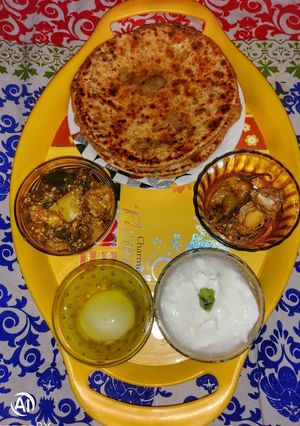
Aloo paratha

Aloo Paratha is a bread dish originating from the Indian subcontinent. It is a breakfast dish originated from the Punjab region. The recipe is one of the most popular breakfast dishes throughout the western, central and northern regions of India as well as the eastern regions of Pakistan.
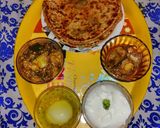
One of the most repeated breakfast in my home is aloo paratha. Everyone loves it. Piping-hot crisp wheat flatbreads stuffed with spiced, faintly sour mashed potatoes stuffing and relished with some tangy sour mango pickle. What is not to love about aloo paratha?
Aloo paratha
Aloo Paratha is a bread dish originating from the Indian subcontinent. It is a breakfast dish originated from the Punjab region. The recipe is one of the most popular breakfast dishes throughout the western, central and northern regions of India as well as the eastern regions of Pakistan.
One of the most repeated breakfast in my home is aloo paratha. Everyone loves it. Piping-hot crisp wheat flatbreads stuffed with spiced, faintly sour mashed potatoes stuffing and relished with some tangy sour mango pickle. What is not to love about aloo paratha?
 Open in Cookpad App
Steps
- 1
First boil 4 medium-sized potatoes. You can boil or steam the potatoes in a pressure cooker, steamer or electric cooker. Add enough water in a 2-litre pressure cooker or pan just about covering the potatoes.
- 2
Peel & chop the boiled warm potatoes. Then mash the potatoes with a potato masher. You can even grate and then mash the potatoes.
- 3
The potatoes should be mashed very well. There should not be any tiny bits of unmashed potatoes
- 4
Now add the chopped green chillies (1 to 2 green chilies, chopped finely), ¼ to ½ teaspoon punjabi garam masala powder or garam masala powder, ¼ to ½ teaspoon kashmiri red chilli powder or deghi mirch (optional), ½ to 1 teaspoon amchur (dry mango powder) and salt as per taste.
- 5
Also add 1 to 2 tablespoons of finely chopped coriander leaves.
- 6
With a spoon or hand, mix the spice powders and green chilies with the mashed potatoes very well. Check the taste and add more salt or red chilli powder or dry mango powder if required.
- 7
In another bowl or pan, take 2 cups whole wheat flour. Make a well in the center. Add ½ teaspoon salt or as required, 1 tablespoon kasuri methi and ¼ tablespoon ajwain.
- 8
Bring the mixture together and knead into a smooth soft dough for 8 to 10 minutes. Add more water if required while kneading. Cover and keep the dough aside for 20 to 30 minutes.
- 9
Pinch balls from the dough. Flatten them and dust with whole wheat flour.
- 10
Roll between your palms and lightly flatten it. Dust with some flour and roll it to a circle of about 5 to 5.5 inches diameter. Place the potato stuffing in the center, keeping about 2 to 2.5 inches space from the sides.
- 11
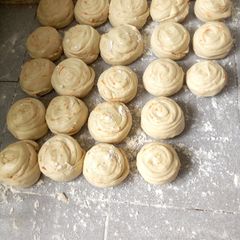
Take the edge and start pleating as well as bringing the pleats in the center.
- 12
Dust some flour on the stuffed paratha and start rolling the aloo paratha.
- 13
Roll the paratha into a round of about 7 to 8 inches in diameter or about the size of a normal roti or chapati.
- 14
Join the pleats together. The pleats have to be joined well, as otherwise there will be gaps while rolling and the filling comes out
- 15
Press the joined top portion slightly downward from the center.
- 16
Sprinkle some flour and roll this version of stuffed paratha to about the same size as that of a chapati or roti. In case if the filling comes out, then just take a small piece of dough and cover the gap.
- 17
Roll to smoothen out the small piece of dough. Try keeping the same thickness throughout while rolling the dough. Avoid keeping the edges thick.
- 18
On a hot tawa (skillet or griddle) place the rolled paratha. The tawa should be hot and not at a low temperature. Cooking parathas at a low flame will harden them. Parathas ideally are crisp as well as soft.
- 19
Keep the flame to medium-high or high for a thick bottomed and heavy tawa. For a medium or thin bottomed and less heavy tawa, keep the flame to medium-low to medium.
- 20
When the base is partly cooked, flip the paratha.
Spread some ghee on the partly cooked part. You can also use oil instead of ghee. If using oil, then use peanut oil or sunflower oil. - 21
Flip again and you will see nice golden blisters on the second side. This time the side which has been spread with ghee will be at the bottom. This side has to be cooked more than the previous side
- 22
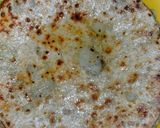
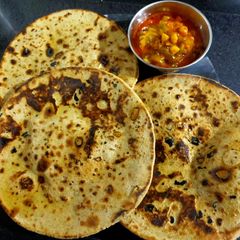
Spread some ghee on the second side facing you. A well made and well-roasted alu paratha will puff up.Flip again once or twice till both the sides are cooked properly. You should see crisp brown spots on the alu paratha. You can also press the paratha edges with a spatula or spoon, so that they are fried well. Since sometimes, the paratha edges are not cooked well. Make all parathas this way.
- 23
You can also serve the aloo paratha directly from the tawa (skillet) straight in the serving plate. Serve some extra butter on the side, along with mango pickle or lemon pickle or dal makhani or some fresh curd (yogurt)

Similar Recipes
More Recipes
-

-

-

-
-
Beef Bulgogi and Ssamjang dipping sauce
-
-

-

-

-
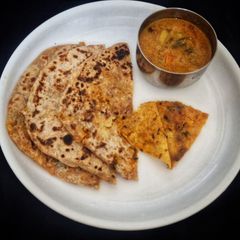
Leftover Sweet Potato Stuffed Paratha

-

-
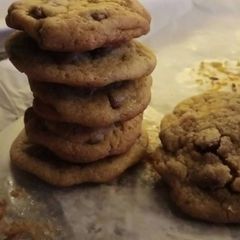
Simple chocolate chips cookies

-

-
-

-


-


-

-
 anamika
 -

-


-

-

-


-


Comments
Presentation also nice👌
🌷
I have also tried some new recipes do see them and like and follow if you wish for added encouragement 🍒