

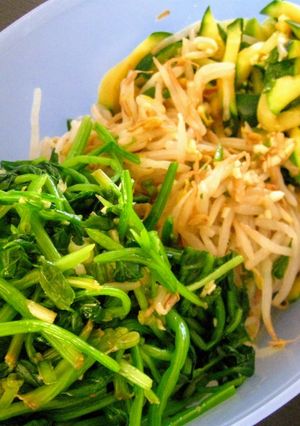
Basic Namul Banchan (Korean Sesame-Garlic Vegetable Side Dish)

Namul (NAHmool) in banchan speak typically refers to vegetable matter made in more of a fresh (not necessarily raw, but as opposed to pickled or preserved) preparation, and often using leafy greens and sprouts. There are several ways to season namul. This particular seasoning is pretty mild, likely familiar to those who have eaten some Korean food, and suitable for making bibim bap.
Certain veg take to this preparation better than others - spinach, bok choy, soy bean sprouts, mung bean sprouts, even dandelion greens and chrysanthemum leaves are all traditional. Though they fall in the category of leafy greens, I wouldn't use dark leafy greens such as kale, collard, beet or turnip greens - too tough and chewy.
Another thing to keep in mind is the volume of the vegetables will reduce from a third to a half after the blanching and squeezing is done (more with spinach). You can use the same water to blanch all the vegetables you're going to make. Just have a colander and some tongs ready to fish out one batch before putting in another.
These seasoning measurements are for roughly 2 cups of blanched vegetables that have been squeezed of the excess liquid and cut into bite sized pieces. Sprouts don't usually need cutting.
P.S. The zucchini in this pic was made bokkeum (stir fry) style. I'll share that recipe another day.
Basic Namul Banchan (Korean Sesame-Garlic Vegetable Side Dish)
Namul (NAHmool) in banchan speak typically refers to vegetable matter made in more of a fresh (not necessarily raw, but as opposed to pickled or preserved) preparation, and often using leafy greens and sprouts. There are several ways to season namul. This particular seasoning is pretty mild, likely familiar to those who have eaten some Korean food, and suitable for making bibim bap.
Certain veg take to this preparation better than others - spinach, bok choy, soy bean sprouts, mung bean sprouts, even dandelion greens and chrysanthemum leaves are all traditional. Though they fall in the category of leafy greens, I wouldn't use dark leafy greens such as kale, collard, beet or turnip greens - too tough and chewy.
Another thing to keep in mind is the volume of the vegetables will reduce from a third to a half after the blanching and squeezing is done (more with spinach). You can use the same water to blanch all the vegetables you're going to make. Just have a colander and some tongs ready to fish out one batch before putting in another.
These seasoning measurements are for roughly 2 cups of blanched vegetables that have been squeezed of the excess liquid and cut into bite sized pieces. Sprouts don't usually need cutting.
P.S. The zucchini in this pic was made bokkeum (stir fry) style. I'll share that recipe another day.
 Open in Cookpad App
Steps
- 1
Bring about 6 cups of water plus 2 teaspoons of salt to a gentle boil. After you put the water on the stove, prepare an ice bath in a large mixing bowl to shock the vegetables after they've been blanched.
- 2
Prepare your vegetables for blanching. Leafy greens always benefit from a good bath in water to release all the dirt and sand accumulated in the growing process. Spinach can be particularly dirty, especially after a good rain, so make sure to wash the spinach as many times as it takes for your water to run clean. Sprouts don't usually need to be washed.
- 3
When the water is gently boiling, place your first batch of vegetables in the water. Contrary to popular wisdom, I actually have had no problems putting as much vegetable matter into the pot as the water will cover.
- 4
Blanch the vegetables until the leafy parts turn a brighter, deeper green and the stalks *just* turn translucent (or in the case of sprouts, until they just turn translucent), no more than 2 or 3 minutes. If you're making spinach, take it out of the water immediately after it starts to wilt, which is probably no more than 30 seconds.
- 5
Take the vegetables out of the boiling water, place them immediately in the ice water bath and give them a good swish, letting them shock (essentially stop cooking) and cool for 3 or 4 minutes before removing them to a strainer/colander. You'll want to throw out some of the water and add more ice to keep the shocking water cold.
- 6
Repeat steps 3 to 5 for the rest of the vegetables and strain in the colander.
- 7
In fist sized batches, and according to type, *thoroughly* squeeze the excess liquid from the vegetables. This takes 2 or 3 squeezes and is an important step to keep from diluting the seasoning.
- 8
Cut into bite sized pieces (1 to 1.5 inches in length), but not the sprouts. We rarely ever cut the sprouts.
- 9
For every 2 cups of prepared vegetables, add the seasonings listed above and toss to season thoroughly and evenly.
- 10
Enjoy as a side dish with your Korean meal, by itself as a snack, or use it to make a yummy bowl of bibimbap! :)

Keywords
Similar Recipes
More Recipes
-

-


-

-


-

-

-

-

-

-
Nikujaga (Simmered meat and potatoes)

-


-
-

-
-

 aanchal puri
 -
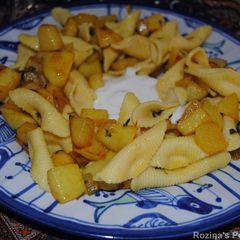
Pasta with fried potatoes and garlic yogrut

-

Deep Fried Bananas With Kachumbari

-

-

-
-

-


-



Comments