

Onigirazu

I wrote a story in April for the "Boston Globe" on onigirazu, since chosen as Japan's 'top dish" for 2015. Here it is:
In Japan, food fads come and go. They can be as fleeting as the cherry blossom petals that bloom and fall to the ground just days later. The latest is a stuffed, roasted seaweed and rice sandwich called onigirazu. It is actually an old fad enjoying a comeback.
Onigirazu is a creative take on the traditional rice ball (called onigiri or omusubi), a standard snack, lunch, or picnic item. To make onigiri, rice is molded with hands wet and salted, into a compact ball or triangle with small bits of pickled plum (umeboshi), seasoned salmon, or dried bonito flakes (katsuobushi) in the center, like a buried treasure. A belt of roasted seaweed hugs the outside of the rice balls. It takes practice and some skill to make and is the food that reminds most Japanese of their moms.
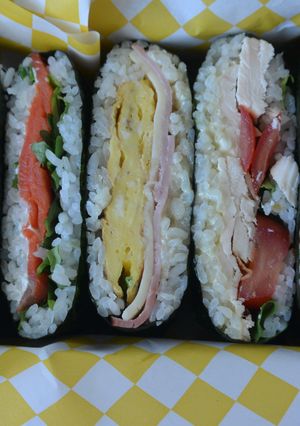
For onigiri to turn into onigirazu, a square of seaweed is layered with warm rice and unconventional fillings like ham, cheese with egg, spicy tuna salad, fried chicken, or some left-over stir-fry. Ketchup and mayonnaise are common condiments used as spreads; greens such as lettuce form demarcations in the layers. You can layer salmon with chive cream cheese and arugula,and roast chicken with tomato and baby lettuces.
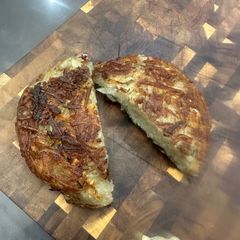
The seaweed is folded around the layers and wrapped in plastic wrap for five minutes so the warm rice and seaweed have time to adhere. Then the stack is cut in half like a sandwich. Some of the combos may sound like strange bedfellows, but they are quite tasty and are a great way to use up all the bits in the refrigerator.
The origin of onigirazu can be traced to a popular mid-1980s food manga called “Cooking Papa.” “The series was about a dad in a family, a ‘salaryman’ who liked to cook,” says Lorie Brau, associate professor of Japanese language and culture at the University of New Mexico, who studies food manga.
The recipe recently made a comeback on Cookpad.com, the most popular Japanese recipe-sharing site, which also has an English language version. “All of a sudden it became a popular search word, and now there are hundreds of recipes for onigirazu on the site,” says Brau. According to Brau, onigirazu, means “not to compress or mold,” which makes this anything-goes rice pillow simple to assemble. Onigirazu should be here to stay.
To see step by step photos go to:
http://www.cookingatdebras.com/2015/05/08/onigirazu/
Onigirazu
I wrote a story in April for the "Boston Globe" on onigirazu, since chosen as Japan's 'top dish" for 2015. Here it is:
In Japan, food fads come and go. They can be as fleeting as the cherry blossom petals that bloom and fall to the ground just days later. The latest is a stuffed, roasted seaweed and rice sandwich called onigirazu. It is actually an old fad enjoying a comeback.
Onigirazu is a creative take on the traditional rice ball (called onigiri or omusubi), a standard snack, lunch, or picnic item. To make onigiri, rice is molded with hands wet and salted, into a compact ball or triangle with small bits of pickled plum (umeboshi), seasoned salmon, or dried bonito flakes (katsuobushi) in the center, like a buried treasure. A belt of roasted seaweed hugs the outside of the rice balls. It takes practice and some skill to make and is the food that reminds most Japanese of their moms.
For onigiri to turn into onigirazu, a square of seaweed is layered with warm rice and unconventional fillings like ham, cheese with egg, spicy tuna salad, fried chicken, or some left-over stir-fry. Ketchup and mayonnaise are common condiments used as spreads; greens such as lettuce form demarcations in the layers. You can layer salmon with chive cream cheese and arugula,and roast chicken with tomato and baby lettuces.
The seaweed is folded around the layers and wrapped in plastic wrap for five minutes so the warm rice and seaweed have time to adhere. Then the stack is cut in half like a sandwich. Some of the combos may sound like strange bedfellows, but they are quite tasty and are a great way to use up all the bits in the refrigerator.
The origin of onigirazu can be traced to a popular mid-1980s food manga called “Cooking Papa.” “The series was about a dad in a family, a ‘salaryman’ who liked to cook,” says Lorie Brau, associate professor of Japanese language and culture at the University of New Mexico, who studies food manga.
The recipe recently made a comeback on Cookpad.com, the most popular Japanese recipe-sharing site, which also has an English language version. “All of a sudden it became a popular search word, and now there are hundreds of recipes for onigirazu on the site,” says Brau. According to Brau, onigirazu, means “not to compress or mold,” which makes this anything-goes rice pillow simple to assemble. Onigirazu should be here to stay.
To see step by step photos go to:
http://www.cookingatdebras.com/2015/05/08/onigirazu/
 Open in Cookpad App
Steps
- 1
Have on hand a roll of plastic wrap and an 8-inch skillet. In a bowl mix together the mayonnaise and wasabi.
- 2
In another bowl beat the eggs. In the skillet over medium heat, heat the oil. Add the eggs and spread them around the pan. Sprinkle with the chives, if using, and cook until the eggs are just set. With a spatula, turn the omelet over and cook 1 minute. Turn out onto a plate. Cut into 5 wedges.
- 3
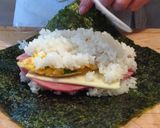
Tear off a 12-inch piece of plastic wrap and lay it on the work surface. Lay 1 sheet of seaweed, on the diagonal, rough side up, in the center of the wrap. Set ⅓ cup of warm rice in the center of the seaweed. With a spatula or back of a spoon lightly spread into a 5-inch square or circle. Spread ½ tablespoon of the mayonnaise mixture over the rice. Set ½ slice of ham on the rice. Cut an omelet wedge into 2 pieces and lay the pieces on the ham so they fit evenly. Place the cheese on the egg and finish with the remaining ½ ham slice. Spread the remaining mayonnaise mixture on the ham. Spread another ⅓ cup of rice over the ham.
- 4
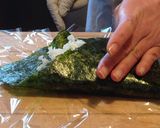
Starting from one bottom corner of seaweed, bring it up and over the layers and hold with your finger. Take the next corner of the seaweed and fold it so that it overlaps slightly with the first corner. Continue folding over the seaweed until all the layers are wrapped in it. Wrap tightly in plastic wrap. Set aside for 5 minutes. Use the remaining rice and filling ingredients to make 4 more sandwiches.
- 5
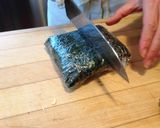
Either keep the plastic on or remove and with a large knife, slice the sandwiches in half. more sandwiches.
Cooksnaps

Keywords
Similar Recipes
More Recipes
-

-


-

-

-

-

-

-
Diet biscuits with custard flavour 🫓 🫓

-


-

-

-


-

-

 cbraun
 -
Floridian backyard grilled chicken

-

-
- cbraun
-

- emcc68
-
 Wayne Brady
 -
 Wayne Brady



Comments