CookpadCookpad
Guest
Register or Log In
Save and create recipes, send cooksnaps and more
  • Search
  • Premium
    • Top Cooksnapped Recipes
    • Top Viewed Recipes
  • Premium
  • Challenges
  • FAQ
  • Send Feedback
  • Region
  • Your Collection
Your Collection
To start creating your recipe library, please register or login.
Onigirazu
Save this recipe to come back to it later.
  • Add Cooksnap
  • Add to folders
  • Print
  • Share
    • Copied!
    • Email
    • Facebook
    • Pin it
    • Twitter
  • Report Recipe
  • See report
  • Edit recipe
  • Delete
CookpadCookpad
A picture of Onigirazu.

Onigirazu

Debra Samuels
Debra Samuels @cook_2575186
Lexington, MA

I wrote a story in April for the "Boston Globe" on onigirazu, since chosen as Japan's 'top dish" for 2015. Here it is:

In Japan, food fads come and go. They can be as fleeting as the cherry blossom petals that bloom and fall to the ground just days later. The latest is a stuffed, roasted seaweed and rice sandwich called onigirazu. It is actually an old fad enjoying a comeback.

Onigirazu is a creative take on the traditional rice ball (called onigiri or omusubi), a standard snack, lunch, or picnic item. To make onigiri, rice is molded with hands wet and salted, into a compact ball or triangle with small bits of pickled plum (umeboshi), seasoned salmon, or dried bonito flakes (katsuobushi) in the center, like a buried treasure. A belt of roasted seaweed hugs the outside of the rice balls. It takes practice and some skill to make and is the food that reminds most Japanese of their moms.

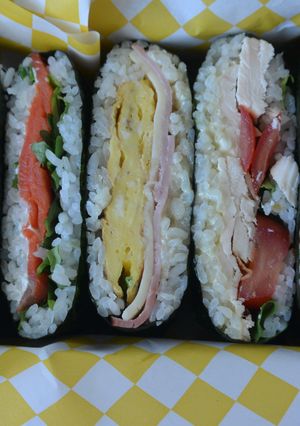
For onigiri to turn into onigirazu, a square of seaweed is layered with warm rice and unconventional fillings like ham, cheese with egg, spicy tuna salad, fried chicken, or some left-over stir-fry. Ketchup and mayonnaise are common condiments used as spreads; greens such as lettuce form demarcations in the layers. You can layer salmon with chive cream cheese and arugula,and roast chicken with tomato and baby lettuces.

The seaweed is folded around the layers and wrapped in plastic wrap for five minutes so the warm rice and seaweed have time to adhere. Then the stack is cut in half like a sandwich. Some of the combos may sound like strange bedfellows, but they are quite tasty and are a great way to use up all the bits in the refrigerator.

The origin of onigirazu can be traced to a popular mid-1980s food manga called “Cooking Papa.” “The series was about a dad in a family, a ‘salaryman’ who liked to cook,” says Lorie Brau, associate professor of Japanese language and culture at the University of New Mexico, who studies food manga.

The recipe recently made a comeback on Cookpad.com, the most popular Japanese recipe-sharing site, which also has an English language version. “All of a sudden it became a popular search word, and now there are hundreds of recipes for onigirazu on the site,” says Brau. According to Brau, onigirazu, means “not to compress or mold,” which makes this anything-goes rice pillow simple to assemble. Onigirazu should be here to stay.

To see step by step photos go to:
http://www.cookingatdebras.com/2015/05/08/onigirazu/

I wrote a story in April for the "Boston Globe" on onigirazu, since chosen as Japan's 'top dish" for 2015. Here it is:

In Japan, food fads come and go. They can be as fleeting as the cherry blossom petals that bloom and fall to the ground just days later. The latest is a stuffed, roasted seaweed and rice sandwich called onigirazu. It is actually an old fad enjoying a comeback.

Onigirazu is a creative take on the traditional rice ball (called onigiri or omusubi), a standard snack, lunch, or picnic item. To make onigiri, rice is molded with hands wet and salted, into a compact ball or triangle with small bits of pickled plum (umeboshi), seasoned salmon, or dried bonito flakes (katsuobushi) in the center, like a buried treasure. A belt of roasted seaweed hugs the outside of the rice balls. It takes practice and some skill to make and is the food that reminds most Japanese of their moms.

For onigiri to turn into onigirazu, a square of seaweed is layered with warm rice and unconventional fillings like ham, cheese with egg, spicy tuna salad, fried chicken, or some left-over stir-fry. Ketchup and mayonnaise are common condiments used as spreads; greens such as lettuce form demarcations in the layers. You can layer salmon with chive cream cheese and arugula,and roast chicken with tomato and baby lettuces.

The seaweed is folded around the layers and wrapped in plastic wrap for five minutes so the warm rice and seaweed have time to adhere. Then the stack is cut in half like a sandwich. Some of the combos may sound like strange bedfellows, but they are quite tasty and are a great way to use up all the bits in the refrigerator.

The origin of onigirazu can be traced to a popular mid-1980s food manga called “Cooking Papa.” “The series was about a dad in a family, a ‘salaryman’ who liked to cook,” says Lorie Brau, associate professor of Japanese language and culture at the University of New Mexico, who studies food manga.

The recipe recently made a comeback on Cookpad.com, the most popular Japanese recipe-sharing site, which also has an English language version. “All of a sudden it became a popular search word, and now there are hundreds of recipes for onigirazu on the site,” says Brau. According to Brau, onigirazu, means “not to compress or mold,” which makes this anything-goes rice pillow simple to assemble. Onigirazu should be here to stay.

To see step by step photos go to:
http://www.cookingatdebras.com/2015/05/08/onigirazu/

Read more

Onigirazu

Debra Samuels
Debra Samuels @cook_2575186
Lexington, MA

I wrote a story in April for the "Boston Globe" on onigirazu, since chosen as Japan's 'top dish" for 2015. Here it is:

In Japan, food fads come and go. They can be as fleeting as the cherry blossom petals that bloom and fall to the ground just days later. The latest is a stuffed, roasted seaweed and rice sandwich called onigirazu. It is actually an old fad enjoying a comeback.

Onigirazu is a creative take on the traditional rice ball (called onigiri or omusubi), a standard snack, lunch, or picnic item. To make onigiri, rice is molded with hands wet and salted, into a compact ball or triangle with small bits of pickled plum (umeboshi), seasoned salmon, or dried bonito flakes (katsuobushi) in the center, like a buried treasure. A belt of roasted seaweed hugs the outside of the rice balls. It takes practice and some skill to make and is the food that reminds most Japanese of their moms.

For onigiri to turn into onigirazu, a square of seaweed is layered with warm rice and unconventional fillings like ham, cheese with egg, spicy tuna salad, fried chicken, or some left-over stir-fry. Ketchup and mayonnaise are common condiments used as spreads; greens such as lettuce form demarcations in the layers. You can layer salmon with chive cream cheese and arugula,and roast chicken with tomato and baby lettuces.

The seaweed is folded around the layers and wrapped in plastic wrap for five minutes so the warm rice and seaweed have time to adhere. Then the stack is cut in half like a sandwich. Some of the combos may sound like strange bedfellows, but they are quite tasty and are a great way to use up all the bits in the refrigerator.

The origin of onigirazu can be traced to a popular mid-1980s food manga called “Cooking Papa.” “The series was about a dad in a family, a ‘salaryman’ who liked to cook,” says Lorie Brau, associate professor of Japanese language and culture at the University of New Mexico, who studies food manga.

The recipe recently made a comeback on Cookpad.com, the most popular Japanese recipe-sharing site, which also has an English language version. “All of a sudden it became a popular search word, and now there are hundreds of recipes for onigirazu on the site,” says Brau. According to Brau, onigirazu, means “not to compress or mold,” which makes this anything-goes rice pillow simple to assemble. Onigirazu should be here to stay.

To see step by step photos go to:
http://www.cookingatdebras.com/2015/05/08/onigirazu/

I wrote a story in April for the "Boston Globe" on onigirazu, since chosen as Japan's 'top dish" for 2015. Here it is:

In Japan, food fads come and go. They can be as fleeting as the cherry blossom petals that bloom and fall to the ground just days later. The latest is a stuffed, roasted seaweed and rice sandwich called onigirazu. It is actually an old fad enjoying a comeback.

Onigirazu is a creative take on the traditional rice ball (called onigiri or omusubi), a standard snack, lunch, or picnic item. To make onigiri, rice is molded with hands wet and salted, into a compact ball or triangle with small bits of pickled plum (umeboshi), seasoned salmon, or dried bonito flakes (katsuobushi) in the center, like a buried treasure. A belt of roasted seaweed hugs the outside of the rice balls. It takes practice and some skill to make and is the food that reminds most Japanese of their moms.

For onigiri to turn into onigirazu, a square of seaweed is layered with warm rice and unconventional fillings like ham, cheese with egg, spicy tuna salad, fried chicken, or some left-over stir-fry. Ketchup and mayonnaise are common condiments used as spreads; greens such as lettuce form demarcations in the layers. You can layer salmon with chive cream cheese and arugula,and roast chicken with tomato and baby lettuces.

The seaweed is folded around the layers and wrapped in plastic wrap for five minutes so the warm rice and seaweed have time to adhere. Then the stack is cut in half like a sandwich. Some of the combos may sound like strange bedfellows, but they are quite tasty and are a great way to use up all the bits in the refrigerator.

The origin of onigirazu can be traced to a popular mid-1980s food manga called “Cooking Papa.” “The series was about a dad in a family, a ‘salaryman’ who liked to cook,” says Lorie Brau, associate professor of Japanese language and culture at the University of New Mexico, who studies food manga.

The recipe recently made a comeback on Cookpad.com, the most popular Japanese recipe-sharing site, which also has an English language version. “All of a sudden it became a popular search word, and now there are hundreds of recipes for onigirazu on the site,” says Brau. According to Brau, onigirazu, means “not to compress or mold,” which makes this anything-goes rice pillow simple to assemble. Onigirazu should be here to stay.

To see step by step photos go to:
http://www.cookingatdebras.com/2015/05/08/onigirazu/

Read more
Saved
Save this recipe to come back to it later.
Edit recipe
See report
Add to folders
Add CooksnapAdd Cooksnap
ShareShare
  • Copied!
  • Email
  • Facebook
  • Pin it
  • Twitter
PrintPrint
  • PrintPrint
  • Add CooksnapAdd Cooksnap
  • Report Recipe
  • See report
  • Delete
Share
  • Copied!
  • Email
  • Facebook
  • Pin it
  • Twitter
Save this recipe to come back to it later.
  • Add Cooksnap
  • Add to folders
  • Print
  • Report Recipe
  • See report
  • Edit recipe
  • Delete

Ingredients

30 mins
4 servings
  • 5 tablespoonsmayonnaise
  • 1 tablespoonwasabi paste, or to taste
  • 2 teaspoonsoil
  • 5eggs
  • 1/4 cupchopped fresh chives or scallions
  • 5 sheetsroasted seaweed
  • 3 1/2 cupscooked rice
  • 5 slicesbaked ham, cut in half
  • 5 slicesHavarti, Muenster, or American cheese
Cookpad Open in Cookpad App
Saved
Save this recipe to come back to it later.

Steps

30 mins
  1. 1

    Have on hand a roll of plastic wrap and an 8-inch skillet. In a bowl mix together the mayonnaise and wasabi.

  2. 2

    In another bowl beat the eggs. In the skillet over medium heat, heat the oil. Add the eggs and spread them around the pan. Sprinkle with the chives, if using, and cook until the eggs are just set. With a spatula, turn the omelet over and cook 1 minute. Turn out onto a plate. Cut into 5 wedges.

  3. 3

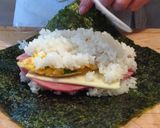
    Tear off a 12-inch piece of plastic wrap and lay it on the work surface. Lay 1 sheet of seaweed, on the diagonal, rough side up, in the center of the wrap. Set ⅓ cup of warm rice in the center of the seaweed. With a spatula or back of a spoon lightly spread into a 5-inch square or circle. Spread ½ tablespoon of the mayonnaise mixture over the rice. Set ½ slice of ham on the rice. Cut an omelet wedge into 2 pieces and lay the pieces on the ham so they fit evenly. Place the cheese on the egg and finish with the remaining ½ ham slice. Spread the remaining mayonnaise mixture on the ham. Spread another ⅓ cup of rice over the ham.
    A picture of step 3 of Onigirazu.
  4. 4

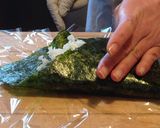
    Starting from one bottom corner of seaweed, bring it up and over the layers and hold with your finger. Take the next corner of the seaweed and fold it so that it overlaps slightly with the first corner. Continue folding over the seaweed until all the layers are wrapped in it. Wrap tightly in plastic wrap. Set aside for 5 minutes. Use the remaining rice and filling ingredients to make 4 more sandwiches.
    A picture of step 4 of Onigirazu.
  5. 5

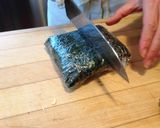
    Either keep the plastic on or remove and with a large knife, slice the sandwiches in half. more sandwiches.
    A picture of step 5 of Onigirazu.
Saved
Save this recipe to come back to it later.
Edit recipe
See report
Add to folders
Add CooksnapAdd Cooksnap
ShareShare
  • Copied!
  • Email
  • Facebook
  • Pin it
  • Twitter
PrintPrint
  • PrintPrint
  • Add CooksnapAdd Cooksnap
  • Report Recipe
  • See report
  • Delete

Cooksnaps

Saved
Save this recipe to come back to it later.
  • Add Cooksnap
  • Add to folders
  • Print
  • Share
    • Copied!
    • Email
    • Facebook
    • Pin it
    • Twitter
  • Report Recipe
  • See report
  • Edit recipe
  • Delete

Copied!

Debra Samuels
Debra Samuels @cook_2575186
on December 18, 2015 00:11
Lexington, MA
Food writer for "The Boston Globe;" author of "My Japanese Table" and "The Korean Table." Lived in Japan for a total of 12 years over a period of 43 years. I am bonkers for bento and bento boxes - I have a collection of about 63 and it's still growing!
Read more

Comments

Guest
Add a comment
0/0

Keywords

Welsh Onion Chive Wasabi American Cheese Rice Egg Ham Mayonnaise

Similar Recipes

More Recipes

  1. A picture of Boozy Shamrock Shake.

    Boozy Shamrock Shake

    Cluelesskitty Cluelesskitty
  2. A picture of How to Make Creamy Strawberry Ice Cream at Home | Easy Homemade Professional Recipe.

    How to Make Creamy Strawberry Ice Cream at Home | Easy Homemade Professional Recipe

    ultra_recipes ultra_recipes
  3. A picture of Professional Chocolate Ice Cream Recipe at Home | Super Creamy, Rich & No Ice Cream Maker.

    Professional Chocolate Ice Cream Recipe at Home | Super Creamy, Rich & No Ice Cream Maker

    ultra_recipes ultra_recipes
  4. A picture of Classic Masala Tandoori Kulhad Chai.

    Classic Masala Tandoori Kulhad Chai

    Shital Jataniya Shital Jataniya
  5. A picture of Professional Homemade Vanilla Ice Cream Recipe | Easy Business-Style Ice Cream at Home.

    Professional Homemade Vanilla Ice Cream Recipe | Easy Business-Style Ice Cream at Home

    ultra_recipes ultra_recipes
  6. A picture of World Cup Malvarma Supo.

    World Cup Malvarma Supo

    Laura Laura
  7. A picture of Sholeh Zard (Persian Saffron Rice Pudding).

    Sholeh Zard (Persian Saffron Rice Pudding)

    Fateme Persian Kitchen Fateme Persian Kitchen
  8. A picture of Monsters Cookie Dip.

    Monsters Cookie Dip

    Ray368523 Ray368523
  9. A picture of Chana Dal - Palak Pakoda with Shahi Chai.

    Chana Dal - Palak Pakoda with Shahi Chai

    culinarycubit culinarycubit
  10. A picture of Paneer Bread Kachori.

    Paneer Bread Kachori

    Guruji Kitchen Guruji Kitchen
  11. A picture of Tres leches cake!!.

    Tres leches cake!!

    Leslie Gonzalez Leslie Gonzalez
  12. A picture of Mike's EZ Crab Cakes.

    Mike's EZ Crab Cakes

    MMOBRIEN MMOBRIEN
  13. A picture of Soft Sugar cookies.

    Soft Sugar cookies

    jcroskey42 jcroskey42
  14. A picture of Fudge Brownie Cookies.

    Fudge Brownie Cookies

    fenway fenway
  15. A picture of Mike's New England Clam Chowder & Homemade Croutons.

    Mike's New England Clam Chowder & Homemade Croutons

    MMOBRIEN MMOBRIEN
  16. A picture of African pumpkin tart.

    African pumpkin tart

    cbraun cbraun
  17. A picture of Floridian backyard grilled chicken.

    Floridian backyard grilled chicken

    skunkmonkey101 skunkmonkey101
  18. A picture of Scalloped Potatoes.

    Scalloped Potatoes

    ktroutman40 ktroutman40
  19. A picture of brown sugar coated ham.

    brown sugar coated ham

    skunkmonkey101 skunkmonkey101
  20. A picture of Chicken Enchiladas .

    Chicken Enchiladas

    cbraun cbraun
  21. A picture of Salmon Croquettes.

    Salmon Croquettes

    Deb Snider Deb Snider
  22. A picture of Crawfish Etouffee.

    Crawfish Etouffee

    emcc68 emcc68
  23. A picture of Breakfast bake.

    Breakfast bake

    Wayne Brady Wayne Brady
  24. A picture of Outrageously good chicken potpie.

    Outrageously good chicken potpie

    cbraun cbraun
  25. A picture of mini breakfast bites.

    mini breakfast bites

    Wayne Brady Wayne Brady
https://cookpad.wasmer.app/us/recipes/280160
Cookpad Open in Cookpad App

About Us

Our mission at Cookpad is to make everyday cooking fun, because we believe that cooking is key to a happier and healthier life for people, communities and the planet. We empower home cooks all over the world to help each other by sharing their recipes and cooking experiences.

Subscribe to Premium for exclusive features & benefits!

Cookpad Communities

🇺🇸 United States 🇬🇧 United Kingdom 🇪🇸 España 🇦🇷 Argentina 🇺🇾 Uruguay 🇲🇽 México 🇨🇱 Chile 🇻🇳 Việt Nam 🇹🇭 ไทย 🇮🇩 Indonesia 🇫🇷 France 🇸🇦 السعودية 🇹🇼 臺灣 🇮🇹 Italia 🇮🇷 ایران 🇮🇳 India 🇭🇺 Magyarország 🇳🇬 Nigeria 🇬🇷 Ελλάδα 🇲🇾 Malaysia 🇵🇹 Portugal 🇺🇦 Україна 🇯🇵 日本 See All

Learn More

Cookpad Premium Careers Feedback Blog Terms of Service Community Guidelines Privacy Policy Frequently Asked Questions

Download our app

Open Cookpad App on Google Play Open Cookpad App on App Store
Copyright © Cookpad Inc. All Rights Reserved
close