

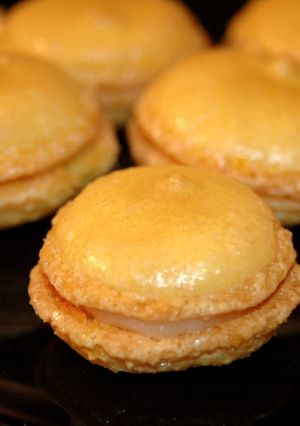
Macarons

This recipe is adapted from Pierre Hermé's original recipe. There are other ways to make macarons, but to me this is the simplest and less technical version.
Macarons
This recipe is adapted from Pierre Hermé's original recipe. There are other ways to make macarons, but to me this is the simplest and less technical version.
 Open in Cookpad App
Steps
- 1
MIXING Mix 150 g of icing sugar with almond powder.
Consistency is strange, like a kind of very light powder. Mixing it with your hands is kind of nice and soothing. - 2
Once the two powders are mixed, we can use a fine flour sifter (if we have one) to remove all the lumps and clumps of sugar and almond powder. It is not at all compulsory but it will definitely improve the fineness of our macarons.
- 3
BEATING It's time to beat the egg whites until they are stiff, but not too stiff. When they become foamy, add 30g of icing sugar and keep on beating while adding progressively the last 70g of icing sugar.
Final consistency must be such that when the spoon is withdrawn, the « little horns » fall back immediately. - 4
MACARONING Then comes the magic moment of the meeting: the egg whites are gently poured into the sugar-almond mixture, then the whites are turned without breaking them, so as to obtain a homogeneous, unctuous, but nevertheless airy paste.
The little bubbles that are trapped in the mixture will make all the difference! (they will make the macarons grow in the oven like a soufflé)
This step is called le macaronage.
- 5
COLOURING But a thought crosses your mind... What about the flavours? When to add chocolate, pistachio or rose?
It's better to add only colourings to the mix, but nothing else (it would endanger the texture and hence the recipe’s success). The flavour will come from the filling.
If you use powder colourings, add them to the dry mix before step 3. If you use liquid colouring, add them to the egg whites before step 3 as well. - 6
SHAPING This is the crucial moment: this is where our work takes shape. Using a piping bag, a plastic freezer bag with one corner bevelled (no need to buy expensive stuff), an elephant syringe (or at least it looks like one), we form our little macarons on a baking sheet AND 2 layers of baking paper (to avoid too much thermal shock).
It's not easy to make perfect little domes. Some of them are too high, too grainy, but we still manage to get something more or less round. - 7
BEATING Don't panic if all your macarons have a little puff on them! After a few minutes of rest, it will almost completely disappear.
To help this happen, give a few taps under your baking sheet (not too hard, though).
- 8
RESTING Resting? Yes, rest. Or even sleep. Indeed, what makes the macaroon so fine is the delightful contrast between the melting inside and the crunchy outside. This crunchiness is obtained by letting your macaroons « crust » for a few hours, or even overnight, in a cool place. If you’re in a hurry, just put them in the fridge 30 min.
When you touch them with your fingertips, they should be hard, ready to let you access their tenderness only with the force of your teeth. - 9
COOKING First of all, you need to preheat the oven to thermostat 6 (180°C). As soon as this temperature is reached (and not before), lower the thermostat to 4 (120°C) and put your macarons in the middle of the oven.
Cook for 10 to 12 minutes, a little more or a little less depending on your oven and the size of your macaroons. Above all, if you see that they are starting to brown, take them out quickly. - 10
SEPARATING Then comes a delicate phase: the macarons may stick to the paper... To prevent the softest part from escaping, run a thin stream of water UNDER the baking paper, which will reduce the macarons' stickiness and allow you to remove them smoothly. Set them aside, on the domed side, of course! (otherwise they'll stick)
For a presentation "like great pastry chefs", you can add pistachio or hazelnut crumbs to your half-macaroons just before baking, or sprinkle with cocoa powder. - 11
MAKING A GANACHE
Now let's work on what'll be between each half-macaron... and bring the flavour!
There are many schools of thought when it comes to filling. Here we’ll use a very simple method: heating some cream in a pan, with some icing sugar and the desired flavour (almond essence, rose essence, pistachio paste, cocoa...). As soon as the mixture has an almost pasty consistency, remove from heat, it's ready. Let it cool a bit. - 12
ASSEMBLING The time has come to assemble the pieces of these gourmet puzzles, to find for each of our little macaroons its "alter ego" in size and shape, sealed by the creamy bonds of the ganache.
A little bit of the mixture, stick a second half-macaroon of similar size on top, then set aside. Your macarons are ready to eat. Put them in the fridge if you wish, or leave them at room temperature, but in a metal box.

Similar Recipes
More Recipes
-
Navratri Arbi or Taro Root Masala Sabzi

-

-

-

-

-
Vrat Special Puffed Rajgira (Amaranth) Raita

-

-
-

-

-

-

-
 Ciara Berry
 -
Blueberry, Pomegranate, Peanut Butter & Plum Jam Overnight Oats

-
 Mariya Balarabe Gambo
 -
Spaghetti with veggies and egg

-


-


-

-


-

-

-





Comments