

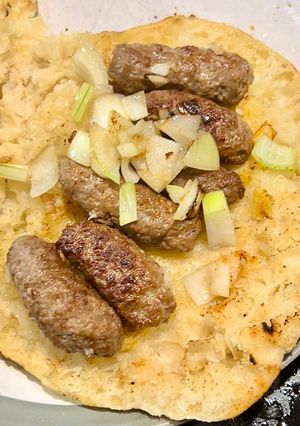
Ćevapčići/Ćevapi (Mini Bosnian Kebabs)

These mini kebabs (“ćevap” being the local pronunciation of “kebab) are considered to be one of the national dishes of Bosnia and Herzegovina 🇧🇦. Tender, juicy and very savoury without being heavily spiced, locals and tourists alike love them. This dish is also a favourite from my childhood. I was hardly more excited than when going with my grandfather to buy them at our local grill, then rushing home to rip open the packaging and eating until I couldn’t move.
The most commonly used meats are beef, or a mixture of beef and lamb. Whilst there is debate about which cut of meat makes the best mince, all agree that it should contain plenty of fat. Mini kebabs are traditionally served in lepina (local Balkan pita bread) with chopped onion 🧅 and kajmak (Balkan cream cheese). If you cannot find lepina bread-which is sometimes available frozen in Middle Eastern supermarkets in the UK-ciabatta or Indian naan bread are both excellent substitutes.
Traditionally, this dish is not something that is commonly made at home from scratch, being the speciality of butchers and the many street food vendors. Each of these has their own secret recipe which they share with nobody! The below is my own authentic version. The keys to success are using fatty mince, very thorough mixing, long marinating time (which tenderises the meat) and short cooking time on a high heat with frequent turning (longer cooking means the juices seep out).
Ćevapčići/Ćevapi (Mini Bosnian Kebabs)
These mini kebabs (“ćevap” being the local pronunciation of “kebab) are considered to be one of the national dishes of Bosnia and Herzegovina 🇧🇦. Tender, juicy and very savoury without being heavily spiced, locals and tourists alike love them. This dish is also a favourite from my childhood. I was hardly more excited than when going with my grandfather to buy them at our local grill, then rushing home to rip open the packaging and eating until I couldn’t move.
The most commonly used meats are beef, or a mixture of beef and lamb. Whilst there is debate about which cut of meat makes the best mince, all agree that it should contain plenty of fat. Mini kebabs are traditionally served in lepina (local Balkan pita bread) with chopped onion 🧅 and kajmak (Balkan cream cheese). If you cannot find lepina bread-which is sometimes available frozen in Middle Eastern supermarkets in the UK-ciabatta or Indian naan bread are both excellent substitutes.
Traditionally, this dish is not something that is commonly made at home from scratch, being the speciality of butchers and the many street food vendors. Each of these has their own secret recipe which they share with nobody! The below is my own authentic version. The keys to success are using fatty mince, very thorough mixing, long marinating time (which tenderises the meat) and short cooking time on a high heat with frequent turning (longer cooking means the juices seep out).
 Open in Cookpad App
Steps
- 1
Boil the garlic in about 50ml water until it comes to an even simmer, then leave to cool. Place the beef mince in a mixing bowl. Add the salt and garlic water to the meat (you may strain it if you prefer). Mix thoroughly and vigorously with the hands. The longer and more thoroughly you mix the meat, the nicer the mini kebabs will be.
- 2
Cover and leave in the fridge for at least 12 hours. Both the salt and garlic will tenderise the meat during this resting time. Using boiled garlic means you get a savoury aroma, but no strong garlic taste.
- 3
After 12 hours, add black pepper and Vegeta to the meat. Mix it once again with your hands (I always wear gloves), being as thorough as possible. The more you work the meat, the better.
- 4
Re-cover and return to the fridge for another 12 hours.
- 5
Dissolve the bicarbonate of soda in the lemon juice, then add this to the meat along with the sparkling water. Mix the meat with your hands again, working the mixture as much as possible.
- 6
Leave the mixture to rest for 1 hour.
- 7
To form the kebabs by hand, break off little pieces of meat and roll them between your hands until you get a thin, even sausage shape about 6-7cm long.
- 8
A faster way-and my preferred method-is to use a piping bag. Simply put the meat in a piping bag, then cut to length. Butchers and street food vendors in the Balkans use a sausage attachment on a meat mincer. If you have access to a meat mincer you can try this method.
- 9
To cook, oil the grill or barbecue and cook mini kebabs on high heat, turning frequently (this should take just a few minutes). You may also fry them. Simply heat cooking oil in a frying pan on high heat and turn frequently until they are done. Do not overcook or cook for too long on a low heat; the result will be dry kebabs.
- 10
Once the kebabs are partially cooked, spread the insides of the Balkan lepina bread (or ciabatta or naan) with some meat stock. Don’t worry; it won’t be too soggy at the end! Open the bread and place on top of the mini kebabs. Cook together until the kebabs are done and the bread warm. You can also cook cubed onion with the bread and kebabs if you don’t want to eat it raw.
- 11
Serve with kajmak, ajvar and extra onion. Enjoy!
- 12
Any leftover raw kebabs freeze very well. If you freeze them, simply cook directly from frozen; no need to defrost first.
Cooksnaps

Similar Recipes
More Recipes
-

-

-

-

-

-

-

-

-

-
California Farm Gari Pickled Sushi Ginger

-


-

-

-
Instant garlic pickle (2 &3) 🧄

-
Maharashtrian Style Kolambi Rassa (Prawn Curry)

-

-

-
Traditional tomato pickle (4) 🍅
-

-

-

-

-



Comments (9)