

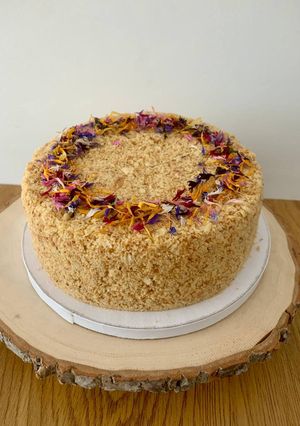
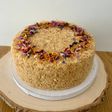
Napoleon cake with crème anglaise and white chocolate cream

Whole recipe of this cake on my channel https://youtu.be/jvB8JnJjU7M
Napoleon cake with crème anglaise and white chocolate cream
Whole recipe of this cake on my channel https://youtu.be/jvB8JnJjU7M
 Open in Cookpad App
Steps
- 1
Crème Anglaise:
Heat the milk and cream in a saucepan. Meanwhile, mix the egg yolks and sugar well with a spatula. - 2
When the milk-cream mixture comes to a boil, pour it in a thin stream into the yolk-sugar mixture while whisking vigorously so the yolks don’t curdle.
- 3
Mix everything thoroughly, pour back into the saucepan, and cook over low heat until it reaches the “reverse” stage (when you draw a circle with the whisk, lift it, and the cream continues the circle, then stops and gently turns in the opposite direction). Or cook strictly by thermometer — remove from heat the moment it hits 82–83°C. Immediately strain into a cold bowl. This stops the cooking process.
- 4
Add the white chocolate and blend with an immersion blender until completely smooth.
- 5
When the cream cools to 35°C, add the soft butter and blend again until silky. Cover with cling film “skin to skin” (directly on the surface) and refrigerate overnight to stabilize.
- 6
Chopped Dough (Flaky Pastry Layers):
Combine the flour with very cold butter (cut into cubes or grated) and rub it with the salt until it turns into crumbs. I do this in a food processor with the paddle attachment. The butter should stay visible as small pieces in the dough before baking. - 7
As soon as the flour is fully mixed with the butter, immediately add the sour cream mixed with the egg yolk and cognac/vodka. Quickly knead everything with the paddle attachment until the dough just comes together. You should see small pieces of butter in the dough.
- 8
Divide the dough into 6–8 equal parts. If you’re short on time, chill in the fridge for 1 hour. If you have time, chill for 5–6 hours. I use a 16 cm (6.3 inch) ring/form and divide the dough into 7 parts.
- 9
Bake at 220°C (425°F) in top-bottom mode until golden brown.
- 10
Cake Assembly:
Roll out each piece of dough very thinly. Your rolled-out dough should be slightly larger than the 16 cm diameter ring — I usually leave an extra 1–2 cm margin all around. The dough will shrink a little during baking, so this extra bit helps you get the perfect size after it’s baked. - 11
Put a tiny bit of cream on the cake board and place the first layer on top. Spread a portion of the cream (I divided the entire volume of cream into seven and a half cake layers).
- 12
Smooth the cream, add the next layer, gently press it down, spread more cream, and repeat with all the layers.
- 13
Flip the last layer upside down. I sprinkle the top with crumbs so the cream doesn’t dry out.
- 14
To help the cake stabilize and soak properly, I place it in a detachable pastry ring before putting it in the fridge. This makes the inside beautifully tender.
- 15
Grind the leftover baked dough scraps in a blender to make fine crumbs.
- 16
The next day:
Take the cake out of the fridge, remove the ring, spread the remaining cream on the sides, and coat the sides generously with the pastry crumbs. You can lightly smooth the sides with a cake spatula. - 17
You can decorate it with fresh berries, dust it with powdered sugar, or leave it simple. I love decorating mine with edible flower petals.
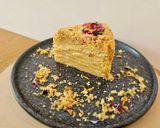
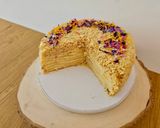
Made this recipe? Share a Cooksnap!
Let Dasha Able know how it turned out.
Nothing says thank you like a photo!

Someone made your recipe and shared a Cooksnap!

Keywords
Similar Recipes
More Recipes
-


-


-


-

-

-

Butternut Squash and Spinach Frittata
-

🌈 Rainbow Lentil Salad with Zesty Lemon Dressing 🥗

-

-

Mom's Iced Orange Cappuccino Frappe

-

Grandmaw Cain's Beef Tips and Rice
-

-

-
-

-


-


-


-


-

-

-


-



Comments