

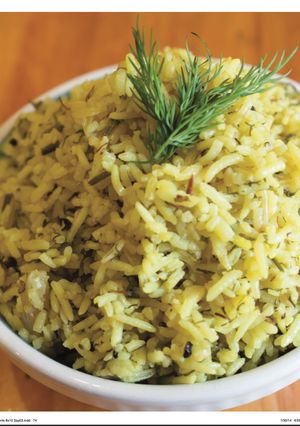
Saffron Rice

Rice is to the Middle East what pasta is to Italy. While rice is a staple in Asian countries, there it is typically served plain; the flavors coming from the sauces for the vegetables, meat or legumes. Iraqi and particularly Iranian rice dishes, on the other hand, are known for their flavours, colours and, especially, their presentation. The way we serve them is something of a ritual. Having more than one rice dish at a meal is not unusual. Sometimes we even make a rice crust on the bottom of a dish so that, when served turned upside down, it looks like a cake.
It took me a long time to get used to making a smaller quantity of rice for dinner. When I was growing up, my mother would serve everyone a big mound of rice topped with whatever stew she had cooked that day. We’d eat the rice with a spoon or by scooping it up with a piece of hubus, or flatbread. I guarantee you that in any traditional Iranian home you’ll find a huge pot of rice on the stove.
The Iranian and Iraqi method of preparing rice: partially cooking it, draining it, then returning it to the pot with fried onion and a touch of water and continuing to cook it very slowly. This method results in delicious dry, almost crispy, rice, but it is time-consuming and the rice loses some of its nutritional value.
Here’s my way:
Saffron Rice
Rice is to the Middle East what pasta is to Italy. While rice is a staple in Asian countries, there it is typically served plain; the flavors coming from the sauces for the vegetables, meat or legumes. Iraqi and particularly Iranian rice dishes, on the other hand, are known for their flavours, colours and, especially, their presentation. The way we serve them is something of a ritual. Having more than one rice dish at a meal is not unusual. Sometimes we even make a rice crust on the bottom of a dish so that, when served turned upside down, it looks like a cake.
It took me a long time to get used to making a smaller quantity of rice for dinner. When I was growing up, my mother would serve everyone a big mound of rice topped with whatever stew she had cooked that day. We’d eat the rice with a spoon or by scooping it up with a piece of hubus, or flatbread. I guarantee you that in any traditional Iranian home you’ll find a huge pot of rice on the stove.
The Iranian and Iraqi method of preparing rice: partially cooking it, draining it, then returning it to the pot with fried onion and a touch of water and continuing to cook it very slowly. This method results in delicious dry, almost crispy, rice, but it is time-consuming and the rice loses some of its nutritional value.
Here’s my way:
 Open in Cookpad App
Steps
- 1
In a pot, heat 1 to 2 Tbsp of the oil over low heat. Sauté the onion in the oil until light golden
- 2
Add the rice and the remaining ingredients, including the remaining 2 to 3 Tbsp oil. Stir to mix well.
- 3
Bring the mixture to a boil, then reduce the heat to low. Taste the cooking liquid— the flavour should be strong, as it will mellow once the water evaporates. Add salt, pepper or stock to taste.
- 4
Let cook, partially covered, until the water has evaporated. Reduce the heat and simmer, tightly covered, for 15 to 20 minutes. Remove the rice from the heat as soon as it is cooked and all the water has evaporated.
- 5
Variation to the above: To jazz up the white rice, add 1⁄2 cup orzo. Sauté with the onion until light golden; continue as directed in the recipe.

Keywords
Similar Recipes
More Recipes
-


-
Lentil and Yogurt Steamed Idli (Dahi mung daal idli)

-

-

-

-

-

-

-

-
 Amanda Jones
 -

-

Quick and Easy Thin Crust Pizza
Gabriel Brown -


-
 Yondu Vegetable Umami
 -

-

Sweet and sour Raw mango chutney

-

-

-
 Maryam Harande
 -







Comments