

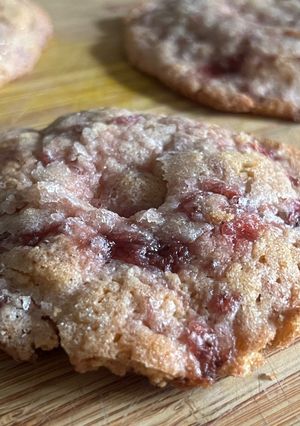
Strawb & Cheesecake Cookies

A form of biscuit dates back to the Ancient Egyptians. ‘Hardtack’ was a simple mixture of flour and water that lasted for months. The Roman army relied on bucellatum which is a type of hard ring-shaped biscuit made from wheat flour, water salt and sometimes lard or oil that was part of their daily rations. The word ‘biscuit’ comes from the Latin biscoctus, via Old French biscuit, meaning twice-cooked.
By the Middle Ages, biscuits became more luxurious. Spices, honey and dried fruits were added and they were often given as gifts. To support long voyages, sailors used hard biscuits that were so tough they often required softening in liquid. The 17th century saw the introduction of butter and sugar into dough.
The word cookie dates from at least 1701 in Scottish usage where the word meant ‘plain bun’ rather than a thin baked good. The Dutch word for a small cake is koekje which is believed to have been anglicised to cookie and was introduced to a new Dutch settlement in the US, New Amsterdam, now known as New York.
It's a mystery as to when a bun or a cake became a cookie and when a biscuit is or is not a cookie. In the UK a biscuit is hard with a crunch (not like in the US where it is like a scone) and a cookie here is often soft and chewy.
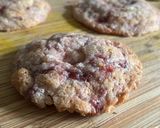
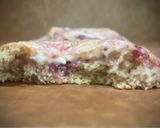
These cookies are flavoured with homemade strawberry jam, filled with cheesecake nobs, dipped in sugar and baked in the oven until slightly crunchy on the edges with an oozy, creamy centre. #March2027
Strawb & Cheesecake Cookies
A form of biscuit dates back to the Ancient Egyptians. ‘Hardtack’ was a simple mixture of flour and water that lasted for months. The Roman army relied on bucellatum which is a type of hard ring-shaped biscuit made from wheat flour, water salt and sometimes lard or oil that was part of their daily rations. The word ‘biscuit’ comes from the Latin biscoctus, via Old French biscuit, meaning twice-cooked.
By the Middle Ages, biscuits became more luxurious. Spices, honey and dried fruits were added and they were often given as gifts. To support long voyages, sailors used hard biscuits that were so tough they often required softening in liquid. The 17th century saw the introduction of butter and sugar into dough.
The word cookie dates from at least 1701 in Scottish usage where the word meant ‘plain bun’ rather than a thin baked good. The Dutch word for a small cake is koekje which is believed to have been anglicised to cookie and was introduced to a new Dutch settlement in the US, New Amsterdam, now known as New York.
It's a mystery as to when a bun or a cake became a cookie and when a biscuit is or is not a cookie. In the UK a biscuit is hard with a crunch (not like in the US where it is like a scone) and a cookie here is often soft and chewy.
These cookies are flavoured with homemade strawberry jam, filled with cheesecake nobs, dipped in sugar and baked in the oven until slightly crunchy on the edges with an oozy, creamy centre. #March2027
 Open in Cookpad App
Steps
- 1
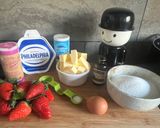
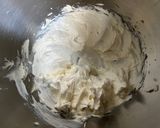
Cheesecake: Line a baking sheet with parchment paper. Add the cream cheese, sugar and vanilla to mixer and whisk on medium-high for around 2 minutes until fluffy and the sugar has dissolved.
- 2
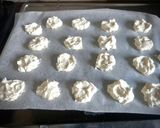
Scoop the cheesecake filling into 13, 2 tsp portions onto the parchment. Slightly flatten each scoop with the back of a spoon so each resembles a thick disc rather than a scooped ball. Place in the freezer until completely frozen.
- 3
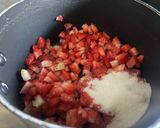
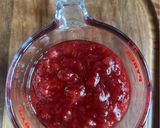
Jam: Hull and dice finely the strawberries and add the sugar to a non-stick pan over medium heat. Cook down for about 45 minutes, stirring occasionally and smashing half way through with a wooden spoon. The jam will become very thick and reduce to around 60-70 ml. Remove from the heat and chill in the fridge.
- 4
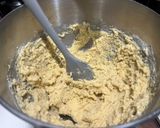
Cookie dough: Preheat the oven to 155℃. Line two baking sheets with parchment paper. Whisk together the flour, baking powder, baking soda and salt then set aside. In a mixer using a paddle, cream the butter and sugar together for 2 minutes until fluffy. Add in the egg and vanilla and mix for 1 – 2 minutes until pale in colour and very fluffy. Add in the dry ingredients. Mix on low speed just until combined.
- 5
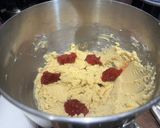
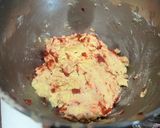
Jam into dough: Push 3/4 of the dough to the side of the bowl. Flatten out 1/4 of the dough on the bottom of the bowl. Spoon 1/4 of the jam onto that section of dough. Add 1/4 of the dough on top of that section and spoon 1/4 of the jam on top. Repeat twice more until the jam is evenly dispersed.
- 6
Cut the dough in quarters with a spatula and fold each section of dough just until the jam is slightly folded in. Don't mix the jam in all the way, you'll want there to be little pockets of jam throughout the dough.
Scoop the dough into 20 portions with a 2 tbsp cookie scoop. Slightly flatten out each then place a frozen cheesecake disc in the centre. Then mould the dough around the cheesecake until it is completely covered. Slightly flatten the dough ball. Roll the cookie dough in sugar.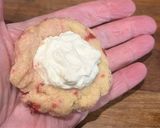
- 7
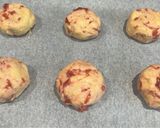
Note: Keep the cheesecake balls in the freezer until ready to use for each batch of cookies. Transfer the cookie dough to a baking sheet lined with parchment paper and bake the cookies for 18 minutes. Let the cookies cool for about 10 minutes on the baking sheet, then transfer to a cooling rack to cool completely.

Similar Recipes
More Recipes
-

-


-

-

-

-

-


-

-

-
-

-
Larry's (next lvl) sausage and cabbage

-

-

-

-
Fruit Custard without custard powder

-

-
Satvik Dhokli Curry | No Onion No Garlic Festive Recipe

-
Eid special vegetable tasty chatpata Mini samosas

-
Fruit And Nuts Chocolate Smoothie







Comments (5)