CookpadCookpad
Guest
Register or Log In
Save and create recipes, send cooksnaps and more
  • Search
  • Premium
    • Top Cooksnapped Recipes
    • Top Viewed Recipes
  • Premium
  • Challenges
  • FAQ
  • Send Feedback
  • Region
  • Your Collection
Your Collection
To start creating your recipe library, please register or login.
Ka’ab El Ghzal - Moroccan gazelle horn pastries
Save this recipe to come back to it later.
  • Add Cooksnap
  • Add to folders
  • Print
  • Share
    • Copied!
    • Email
    • Facebook
    • Pin it
    • Twitter
  • Report Recipe
  • See report
  • Edit recipe
  • Delete
CookpadCookpad
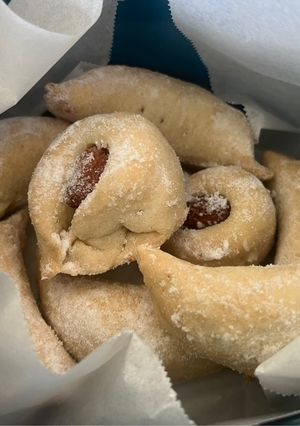
A picture of Ka’ab El Ghzal - Moroccan gazelle horn pastries.

Ka’ab El Ghzal - Moroccan gazelle horn pastries

Laura
Laura @FeelBetter
Milton Keynes, England

Ka’ab El Ghzal is a classic Moroccan pastry made with a flour-based dough wrapped around an almond paste filling flavoured with ma’zaher (orange blossom water) and covered in a thin pastry.

The name ka’ab el gzhal, is often mistranslated as ‘gazelle horn’ due to its elongated crescent-shaped appearance being reminiscent of the horns of this animal. A better translation would be gazelle ankle. Ka’ab, is the source of the name Yakov or Jacob who was born clutching the heel of his twin brother but it also refers to a heel denoting something bulging or protruding, which in this case is the filling.

The dough was originally made with smen (salted, fermented, clarified butter made with sheep’s milk) but nowadays it is common to find butter made from cow’s milk. A little meska (Arabic gum) is added to the dough to help stabilise and make it smooth. This fabulous jewel of an ingredient is the sap of wild acacia trees which grow throughout the Sahel region from Senegal to Somalia. 80% of commercial production is centred in Sudan.

The pastries are shaped then baked and dipped in more ma’zaher and icing sugar. Ma’zaher has a rich history dating back to the 17th century in Middle Eastern cuisine and is a distillation of fresh bitter orange blossoms which adds a wonderful scent and flavour to the pastries.

Serve on a silver tray with Moroccan mint tea (see recipe) or wrap individually, seal with gold or silver ribbon and gift to friends and/or neighbours. #March2026 #CA2025

Ka’ab El Ghzal is a classic Moroccan pastry made with a flour-based dough wrapped around an almond paste filling flavoured with ma’zaher (orange blossom water) and covered in a thin pastry.

The name ka’ab el gzhal, is often mistranslated as ‘gazelle horn’ due to its elongated crescent-shaped appearance being reminiscent of the horns of this animal. A better translation would be gazelle ankle. Ka’ab, is the source of the name Yakov or Jacob who was born clutching the heel of his twin brother but it also refers to a heel denoting something bulging or protruding, which in this case is the filling.

The dough was originally made with smen (salted, fermented, clarified butter made with sheep’s milk) but nowadays it is common to find butter made from cow’s milk. A little meska (Arabic gum) is added to the dough to help stabilise and make it smooth. This fabulous jewel of an ingredient is the sap of wild acacia trees which grow throughout the Sahel region from Senegal to Somalia. 80% of commercial production is centred in Sudan.

The pastries are shaped then baked and dipped in more ma’zaher and icing sugar. Ma’zaher has a rich history dating back to the 17th century in Middle Eastern cuisine and is a distillation of fresh bitter orange blossoms which adds a wonderful scent and flavour to the pastries.

Serve on a silver tray with Moroccan mint tea (see recipe) or wrap individually, seal with gold or silver ribbon and gift to friends and/or neighbours. #March2026 #CA2025

Read more

Ka’ab El Ghzal - Moroccan gazelle horn pastries

Laura
Laura @FeelBetter
Milton Keynes, England

Ka’ab El Ghzal is a classic Moroccan pastry made with a flour-based dough wrapped around an almond paste filling flavoured with ma’zaher (orange blossom water) and covered in a thin pastry.

The name ka’ab el gzhal, is often mistranslated as ‘gazelle horn’ due to its elongated crescent-shaped appearance being reminiscent of the horns of this animal. A better translation would be gazelle ankle. Ka’ab, is the source of the name Yakov or Jacob who was born clutching the heel of his twin brother but it also refers to a heel denoting something bulging or protruding, which in this case is the filling.

The dough was originally made with smen (salted, fermented, clarified butter made with sheep’s milk) but nowadays it is common to find butter made from cow’s milk. A little meska (Arabic gum) is added to the dough to help stabilise and make it smooth. This fabulous jewel of an ingredient is the sap of wild acacia trees which grow throughout the Sahel region from Senegal to Somalia. 80% of commercial production is centred in Sudan.

The pastries are shaped then baked and dipped in more ma’zaher and icing sugar. Ma’zaher has a rich history dating back to the 17th century in Middle Eastern cuisine and is a distillation of fresh bitter orange blossoms which adds a wonderful scent and flavour to the pastries.

Serve on a silver tray with Moroccan mint tea (see recipe) or wrap individually, seal with gold or silver ribbon and gift to friends and/or neighbours. #March2026 #CA2025

Ka’ab El Ghzal is a classic Moroccan pastry made with a flour-based dough wrapped around an almond paste filling flavoured with ma’zaher (orange blossom water) and covered in a thin pastry.

The name ka’ab el gzhal, is often mistranslated as ‘gazelle horn’ due to its elongated crescent-shaped appearance being reminiscent of the horns of this animal. A better translation would be gazelle ankle. Ka’ab, is the source of the name Yakov or Jacob who was born clutching the heel of his twin brother but it also refers to a heel denoting something bulging or protruding, which in this case is the filling.

The dough was originally made with smen (salted, fermented, clarified butter made with sheep’s milk) but nowadays it is common to find butter made from cow’s milk. A little meska (Arabic gum) is added to the dough to help stabilise and make it smooth. This fabulous jewel of an ingredient is the sap of wild acacia trees which grow throughout the Sahel region from Senegal to Somalia. 80% of commercial production is centred in Sudan.

The pastries are shaped then baked and dipped in more ma’zaher and icing sugar. Ma’zaher has a rich history dating back to the 17th century in Middle Eastern cuisine and is a distillation of fresh bitter orange blossoms which adds a wonderful scent and flavour to the pastries.

Serve on a silver tray with Moroccan mint tea (see recipe) or wrap individually, seal with gold or silver ribbon and gift to friends and/or neighbours. #March2026 #CA2025

Read more
Saved
Save this recipe to come back to it later.
Edit recipe
See report
Add to folders
Add CooksnapAdd Cooksnap
ShareShare
  • Copied!
  • Email
  • Facebook
  • Pin it
  • Twitter
PrintPrint
  • PrintPrint
  • Add CooksnapAdd Cooksnap
  • Report Recipe
  • See report
  • Delete
Share
  • Copied!
  • Email
  • Facebook
  • Pin it
  • Twitter
Save this recipe to come back to it later.
  • Add Cooksnap
  • Add to folders
  • Print
  • Report Recipe
  • See report
  • Edit recipe
  • Delete

Ingredients

15 - 20 minutes
21 pastries
  • Filling (almond paste):
  • 275 gwith skins or without – I did half and half
  • 125 gwhite granulated sugar
  • 30 gbutter, softened
  • 1 tsporange blossom water
  • 5 gpebbles of gum Arabic (meska)
  • Dough:
  • 250 gplain flour
  • good pinch salt
  • 4 tbspbutter, softened
  • 3 tbsporange blossom water
  • 1little cold water
  • Extras:
  • unpeeled almonds
  • To serve:
  • Moroccan mint tea
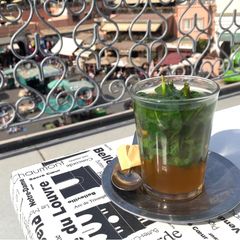
    Whisky Berbère - Moroccan mint tea
Cookpad Open in Cookpad App
Saved
Save this recipe to come back to it later.

Steps

15 - 20 minutes
  1. 1

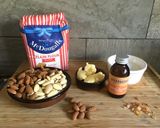
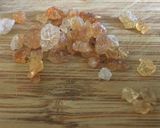
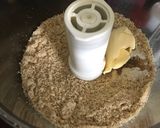
    Paste: Add a pinch of sugar to the meska (gum Arabic) and crush using a pestle and mortar into a fine powder. In a food processor, add the blanched almonds and blitz in a food processor until the mixture is powdery. Note: do not process for too long as the oil will start to seep from the almonds.
    A picture of step 1 of Ka’ab El Ghzal - Moroccan gazelle horn pastries.
    A picture of step 1 of Ka’ab El Ghzal - Moroccan gazelle horn pastries.
    A picture of step 1 of Ka’ab El Ghzal - Moroccan gazelle horn pastries.
  2. 2

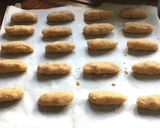
    Add the meska, sugar, softened butter and orange blossom water and continue processing until comes together into a smooth paste. If it won’t come together try warming it or adding a little milk. Divide the almond paste into 20g pieces around 6 cm long x 2 cm wide. Shape into slightly elongated balls and cover to prevent drying.
    A picture of step 2 of Ka’ab El Ghzal - Moroccan gazelle horn pastries.
    A picture of step 2 of Ka’ab El Ghzal - Moroccan gazelle horn pastries.
  3. 3

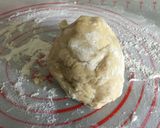
    Dough: In a bowl combine the flour and salt. Add the orange blossom water and butter either by rubbing with fingertips or using a food processor. If the dough is too crumbly add more cold water little by little until can form a ball of dough. It should be soft but not sticky. Divide into 4 portions, make each into a ball, cover and let it rest for at least 15 minutes in the fridge.
    A picture of step 3 of Ka’ab El Ghzal - Moroccan gazelle horn pastries.
  4. 4

    Lightly dust the work surface with flour. Roll out the dough as thin as possible. Should be almost transparent. Place almond piece/pieces on the dough and fold the dough over to enclose the filling. Press and shape to form a crescent ensuring the edges are well sealed. Using a pastry cutter cut around leaving a small edge.
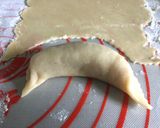
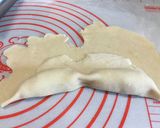
    A picture of step 4 of Ka’ab El Ghzal - Moroccan gazelle horn pastries.
    A picture of step 4 of Ka’ab El Ghzal - Moroccan gazelle horn pastries.
  5. 5

    A fancier finish is to join the ends of the piece together to create a horseshoe and place an almond in the centre.

    Cover the pieces and let them dry.
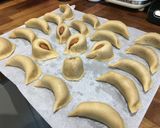
    A picture of step 5 of Ka’ab El Ghzal - Moroccan gazelle horn pastries.
  6. 6

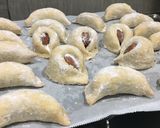
    Bake: Preheat the oven to 160ºC fan. Prick the base of each piece and the sides so that the steam can be released during baking. Place in the centre of the oven for 15 - 20 minutes. The gazelle horns should be white, not brown. Remove from the oven and let cool completely on a wire rack. Dip in orange blossom water and then in icing sugar.
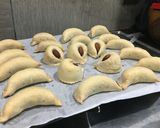
    A picture of step 6 of Ka’ab El Ghzal - Moroccan gazelle horn pastries.
    A picture of step 6 of Ka’ab El Ghzal - Moroccan gazelle horn pastries.
    A picture of step 6 of Ka’ab El Ghzal - Moroccan gazelle horn pastries.
  7. 7

    Note:
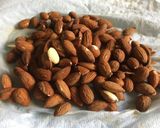
    If you wish to peel the almonds, add to boiling water for 1 minute before straining and soaking in cold water. Peels should come off easily.
    A picture of step 7 of Ka’ab El Ghzal - Moroccan gazelle horn pastries.

Linked Recipes

Whisky Berbère - Moroccan mint tea

Saved
Save this recipe to come back to it later.
Edit recipe
See report
Add to folders
Add CooksnapAdd Cooksnap
ShareShare
  • Copied!
  • Email
  • Facebook
  • Pin it
  • Twitter
PrintPrint
  • PrintPrint
  • Add CooksnapAdd Cooksnap
  • Report Recipe
  • See report
  • Delete

Cooksnaps

Saved
Save this recipe to come back to it later.
  • Add Cooksnap
  • Add to folders
  • Print
  • Share
    • Copied!
    • Email
    • Facebook
    • Pin it
    • Twitter
  • Report Recipe
  • See report
  • Edit recipe
  • Delete

Copied!

Laura
Laura @FeelBetter
on March 31, 2025 18:30
Milton Keynes, England
Out and Out FoodieSandgrounder#FeelBetterMK
Read more

Comments

Guest
Add a comment
0/0

Similar Recipes

More Recipes

  1. A picture of Collard Green - Bean Salad.

    Collard Green - Bean Salad

    Spencer Spencer
  2. A picture of Honey bunny.

    Honey bunny

    Kotsume Kotsume
  3. A picture of Pearl Millet and Amaranth Flour Sukhdi (Bajra Flour and Rajgira Flour Sukhdi).

    Pearl Millet and Amaranth Flour Sukhdi (Bajra Flour and Rajgira Flour Sukhdi)

    Sangita Vyas Sangita Vyas
  4. A picture of Ragi Veggie Idli.

    Ragi Veggie Idli

    Shobha Deshmukh Shobha Deshmukh
  5. A picture of Onion Jowar Atta Pakoda.

    Onion Jowar Atta Pakoda

    Nutan Shah Nutan Shah
  6. A picture of No Bread Sandwich.

    No Bread Sandwich

    Bina Anjaria Bina Anjaria
  7. A picture of Potato Fry.

    Potato Fry

    Ameya Bhat Ameya Bhat
  8. A picture of Soya Kebab.

    Soya Kebab

    Ameya Bhat Ameya Bhat
  9. A picture of Sweet Treats in Minutes.

    Sweet Treats in Minutes

    Arezu Arezu
  10. A picture of Rajgira Flour Roti.

    Rajgira Flour Roti

    Suchitra S(Radhika S) Suchitra S(Radhika S)
  11. A picture of Japanese egg sandwiches.

    Japanese egg sandwiches

    ayaeats | Ayaka ayaeats | Ayaka
  12. A picture of Honey Walnut Shrimp.

    Honey Walnut Shrimp

    Jea Jea
  13. A picture of Husband Casserole.

    Husband Casserole

    christopherfowler70 christopherfowler70
  14. A picture of Coca-Cola Braised Chicken.

    Coca-Cola Braised Chicken

    Kayden Kayden
  15. A picture of Minestrone Soup!.

    Minestrone Soup!

    Jackie Vitiello Jackie Vitiello
  16. A picture of Delicious refreshing Mohabbat ka Sharbat.(Sharbat-e- Mohabbat).

    Delicious refreshing Mohabbat ka Sharbat.(Sharbat-e- Mohabbat)

    Ramaben Joshi Ramaben Joshi
  17. A picture of Chhena Poda.

    Chhena Poda

    Alka Bhandari Alka Bhandari
  18. A picture of Anything Som Tum.

    Anything Som Tum

    Kasey Coffey Kasey Coffey
  19. A picture of Moria's pudding.

    Moria's pudding

    Heenaba jadeja Heenaba jadeja
  20. A picture of Whisky Berbère - Moroccan mint tea.

    Whisky Berbère - Moroccan mint tea

    Laura Laura
  21. A picture of Khatti Dal (Tangy Lentil Curry - Hyderabadi style).

    Khatti Dal (Tangy Lentil Curry - Hyderabadi style)

    Bethica Das Bethica Das
  22. A picture of Besan Pakoda.

    Besan Pakoda

    Sudipa Gope Sudipa Gope
  23. A picture of Khao Khua Toasted Rice Powder.

    Khao Khua Toasted Rice Powder

    Kasey Coffey Kasey Coffey
  24. A picture of Honey Walnut Shrimp.

    Honey Walnut Shrimp

    Jea Jea
  25. A picture of Japanese egg sandwiches.

    Japanese egg sandwiches

    ayaeats | Ayaka ayaeats | Ayaka
https://cookpad.wasmer.app/us/recipes/24609736
Cookpad Open in Cookpad App

About Us

Our mission at Cookpad is to make everyday cooking fun, because we believe that cooking is key to a happier and healthier life for people, communities and the planet. We empower home cooks all over the world to help each other by sharing their recipes and cooking experiences.

Subscribe to Premium for exclusive features & benefits!

Cookpad Communities

🇺🇸 United States 🇬🇧 United Kingdom 🇪🇸 España 🇦🇷 Argentina 🇺🇾 Uruguay 🇲🇽 México 🇨🇱 Chile 🇻🇳 Việt Nam 🇹🇭 ไทย 🇮🇩 Indonesia 🇫🇷 France 🇸🇦 السعودية 🇹🇼 臺灣 🇮🇹 Italia 🇮🇷 ایران 🇮🇳 India 🇭🇺 Magyarország 🇳🇬 Nigeria 🇬🇷 Ελλάδα 🇲🇾 Malaysia 🇵🇹 Portugal 🇺🇦 Україна 🇯🇵 日本 See All

Learn More

Cookpad Premium Careers Feedback Blog Terms of Service Community Guidelines Privacy Policy Frequently Asked Questions

Download our app

Open Cookpad App on Google Play Open Cookpad App on App Store
Copyright © Cookpad Inc. All Rights Reserved
close